
Tulsa County Parole Versus Probation
Oklahoma assigns two different functions to agencies that readers often blend together. The Oklahoma Pardon and Parole Board considers parole and clemency matters. Oklahoma Department of Corrections Probation and Parole Services supervises people in the community. A Board vote, recommendation, or docket entry is one step in the process. It is not proof that a person walked out of a prison on that date. Required action, release processing, stipulations, another sentence, or a detainer may still stand between the decision and physical release.
Parole is conditional release from prison before the correctional sentence is fully discharged. Probation is court-ordered supervision that may be imposed instead of incarceration or after some custody. Both can require reporting and compliance, yet neither means the same thing as discharge. Discharge generally marks the end of the applicable sentence or supervision term. Other cases still must be checked.
| Point | Parole | Probation |
|---|---|---|
| How it begins | Release from imprisonment under conditions | A court orders community supervision |
| Decision source | Parole process under Oklahoma law | Judgment and sentence from the court |
| Local supervision | ODOC Probation and Parole Services | ODOC Probation and Parole Services when assigned |
| What ends it | Expiration or formal discharge of the term | Completion or court action affecting the term |
Check Tulsa County Supervision Status
Begin with the ODOC Offender Lookup. It can show status, location or supervision, sentence information, and identifiers, depending on the record and current interface. ODOC warns that its lookup changed data sources and may have unexpected issues. A missing or surprising result needs a second source. Match an ODOC number when known. Otherwise compare the name, birth information, conviction county, sentence, and any photo or physical description shown.
Use the following order to keep a release event separate from a supervision status:
- Search ODOC by number or exact name, then try known aliases if the first search fails.
- Match at least two identity details before reading the status or supervision location.
- Distinguish incarcerated, paroled or supervised, and discharged language. Do not rewrite one term as another.
- Review the Tulsa case in the OSCN Tulsa docket search for the judgment, sentence, warrant, or later court order.
- If the record names community supervision, use ODOC's current directory and the assigned officer's instructions.
- For physical release confirmation, check the custody agency record rather than treating a parole vote as a release receipt.
The Tulsa County released-inmate search path explains how to pair the custody event with the court authority. That pairing matters when one case closes while another hold remains. It also guards against mistaking transfer to ODOC for release to the community.
The Tulsa County Inmate Information Center can confirm a current county-jail match at the time searched. It cannot prove supervision when the person no longer appears. Use ODOC for that status.
Note: An ODOC supervision status can confirm release from prison without proving that every other Tulsa County case has ended.
Tulsa County Parole Office
ODOC's official district directory identifies the main Tulsa Probation and Parole office as the local supervision point. The directory also contains a suboffice entry with an apparent ZIP-code conflict, so the main district listing is the safer public reference unless ODOC confirms a different reporting site. A person under supervision should follow instructions from the assigned officer. A web directory alone is not an order to report at a certain place or time.
201 W. 5th Street, Suite 200
Tulsa, OK 74103
Phone: 918-581-2931
Fax: 918-581-2694
Service area: Tulsa County
The office is a community-supervision site, not a jail and not a public walk-in roster. Staff may help resolve reporting or record questions when disclosure is authorized, but protected case-management details may not be released. Check the ODOC Probation and Parole Services directory before relying on the contact details because offices and assignments can change.
Tulsa County Parole Decision Records
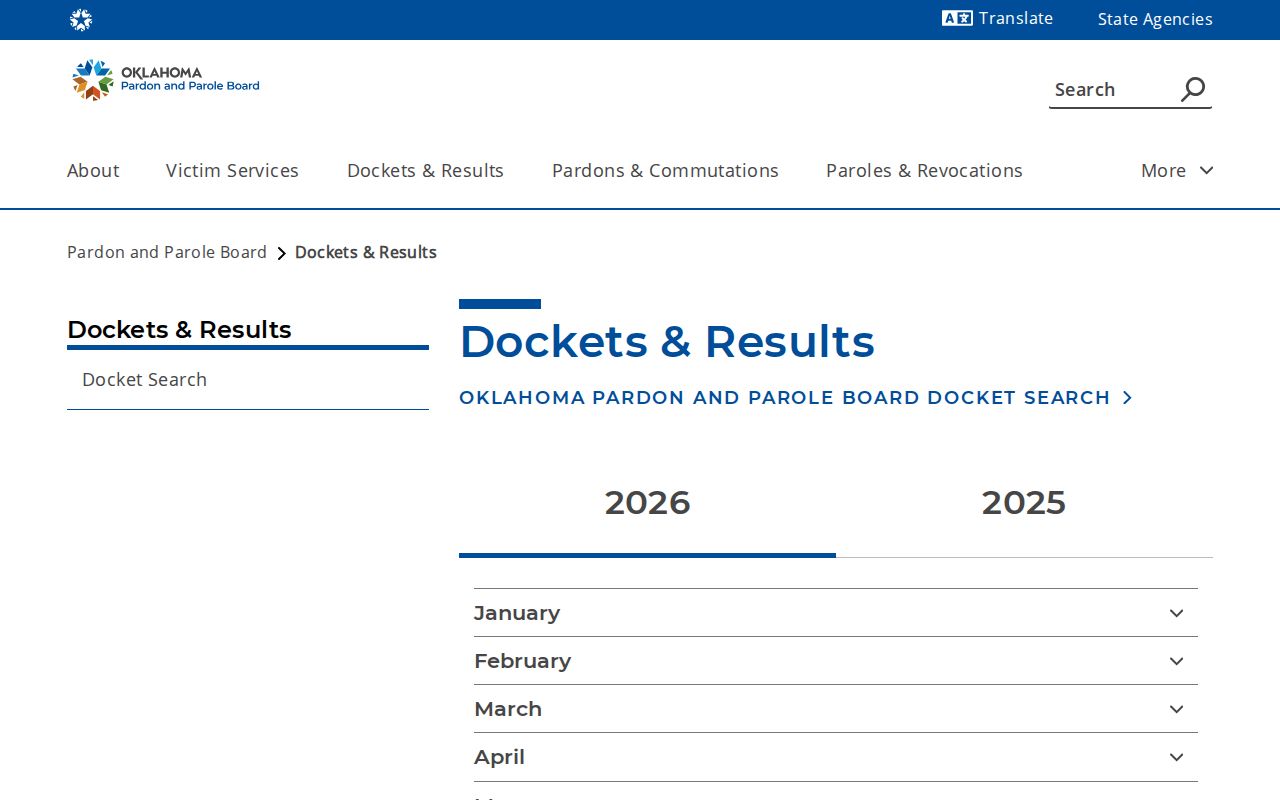
The Pardon and Parole Board publishes monthly dockets and results. A docket is a schedule of matters for consideration, not a list of people released. Search by ODOC number rather than name alone. Results may distinguish a parole-eligibility date, projected release date, Board action, pass or deferral, denial, or another procedural outcome. Even language such as “Parole to Street” may include prerelease stipulations and does not show that release happened on the meeting date.
The PPB docket and results inventory is the official starting point. The captured view below shows how monthly materials are organized.
Use the result as evidence of the Board's action, then confirm execution through ODOC or OK VINE. Keep three dates separate: eligibility, the Board's consideration or decision, and actual physical release. Eligibility depends on the governing statute, offense date, sentence, and restrictions. It cannot be found by applying one simple percentage to every sentence.
Oklahoma's process can also differ by offense category and date. Some favorable actions grant parole, while others are recommendations that require further action. A pass, deferral, or matter stricken from the docket is not a denial and is not a release. Read the legend supplied with that month's results. Then check whether ODOC changed the person to a parole or community-supervision status. That later status is stronger proof that prison custody ended than the meeting calendar alone.
Tulsa County Supervision Warrants
An absconder is a person alleged to have stopped required contact with supervision. ODOC provides an official fugitive search, and its Fugitive Warrants Division lists 405-425-2570, 405-425-2571, toll-free 866-363-1119, and warrants@doc.ok.gov. The agency warns the public not to act on a listing. A fugitive or absconder notation does not give a present location, prove a new offense, or establish the date of the earlier release.
A warrant may explain why someone released on one Tulsa County matter can return to custody. It may also arise from another case. Verify that a warrant remains active with the issuing agency and match the correct person. Social posts are not a sound substitute. Current ODOC and court records provide the needed agency context.
Tulsa County Supervision Terms
Conditions are the rules attached to parole or probation. They may involve reporting, approved residence or travel, program participation, payment duties set by the judgment, or restrictions tied to the case. The exact terms come from the court, release documents, and supervising agency. Public status data does not disclose every case-management detail. A violation is an alleged failure to follow a condition. It can lead to a response from the officer, a warrant, a hearing, modification, or renewed custody, depending on the authority and facts.
OK VINE is useful for custody changes, but it does not replace the supervision record. The Pardon and Parole Board states that Oklahoma VINE does not provide parole notification. Its registered-victim process is separate. VINE can also become inactive while an ODOC inmate is transferred to an Oklahoma mental-health facility, then resume on return to DOC custody. A missing alert therefore cannot be read as proof of release or discharge.
- Parole
- Conditional release from prison while the sentence remains under supervision.
- Probation
- Court-ordered community supervision that may replace or follow custody.
- Absconder
- A person alleged to have stopped required contact with supervision.
- Discharge
- Formal completion of the applicable correctional or supervision term.
- Detainer
- A request or hold from another authority that can affect release.
Note: “Under supervision” shows that secure custody ended, but it does not mean the sentence has been fully discharged.
Property After Tulsa County Release
Post-release tasks do not all belong to the supervision office. The David L. Moss Criminal Justice Center has a specific property route. TCSO directs people to schedule pickup with the property clerk at 918-596-8872. Posted pickup hours are Monday through Friday, 8:00 a.m. to 4:00 p.m., with observed holidays closed. The jail itself runs around the clock, but that does not make property service available at all hours.
The TCSO Jail Information page is the source for those logistics. Property staff should not be treated as the release-record desk or the assigned parole officer. For an error in the underlying release record, contact the office that created the record and supply the booking number plus any supporting court order. The portal vendor should not be asked to alter the authoritative custody record.
Tulsa County Supervision Discharge
Supervision ends through expiration, formal discharge, or a lawful court or agency action that changes the term. The exact record depends on whether the person was on parole or probation. For parole tied to an ODOC sentence, use ODOC sentence and discharge records. For probation, read the Tulsa judgment, later court orders, and the supervision status. A closed case label by itself may not settle the issue because another count or case can continue.
Oklahoma's Open Records Act starts at 51 O.S. §24A.1. Public access remains subject to statutes that protect private or sealed material. The record custodian applies exemptions and should provide separable public portions when the law calls for it. When an online result and the official document differ, ask the agency that created the record to explain or correct the conflict.
For an ODOC record that remains unclear, the agency's Legal Services page identifies Sentence Administration, Offender Records, and Registries contacts. It lists osordischarges@doc.ok.gov for discharge matters, osor@doc.ok.gov for inquiries, and 405-425-2691 for Closed Records. Some nonpublic material may require a signed authorization. Request only the record needed and state the ODOC number, sentence, and date range so staff can distinguish discharge from a change of location.