
Federal Releases in Tulsa Cases
Federal custody serving Tulsa County cases is a network of authorities, not one local institution. The Bureau of Prisons holds sentenced federal prisoners in institutions across the nation. The U.S. Marshals Service manages many federal pretrial and transport situations and may use contract space. The U.S. District Court for the Northern District of Oklahoma creates the detention, release, judgment, and supervised-release orders found in the federal docket.
A BOP release may mean return to the community, the start of federal supervised release, or transfer to another authority. “Not in BOP custody” describes only BOP scope. It does not rule out USMS, ICE, Oklahoma, Tulsa County, another state, or a new local booking. The destination field and court record matter as much as the locator status.
| Federal source | What it can establish |
|---|---|
| BOP Inmate Locator | Historical or current BOP status, including released wording and a release date when shown. |
| PACER federal docket | Detention and release orders, judgment, revocation, and supervised-release events. |
| U.S. Marshals Service | Routing for pretrial or transported prisoners who may not yet appear in BOP. |
| ICE locator and ERO | Follow-on immigration custody after another authority’s release. |
| Holding jail record | The local facility transaction, which must be tied to the legal federal custodian. |
Search Federal BOP Release Records
The BOP Inmate Locator covers federal inmates from 1982 forward and some older records. Search by register, DCDC, FBI, or INS number when one is known. Those identifiers are stronger than a name. A name search can also use age, race, and sex to narrow the results, but each field must be matched carefully.
- Choose the identifier search when a federal register or other supported number is available.
- For a name search, enter the exact spelling and use the listed identity filters to separate namesakes.
- Compare the returned name, register number, age, race, and sex with the court record.
- Read the release date and location or status exactly as BOP displays them.
- Check PACER and any receiving agency before treating a BOP release as community freedom.
BOP notes that a release date may not immediately reflect every First Step Act calculation. Save the access date and avoid recalculating the sentence from a judgment alone. If the locator says “Released” or “Not in BOP Custody,” preserve that exact phrase rather than broadening it beyond BOP.
Federal Release Locator Fields
A federal result should be read as a set of linked fields. Identity fields protect against a namesake error. The release field describes the BOP record. Location or status places that field within BOP scope. The court case then supplies the legal context.
| Locator field | How to read it |
|---|---|
| Name | Compare spelling and aliases with the federal case. |
| Register number | Use as the main BOP identifier for records follow-up. |
| Age, race, and sex | Use only as identity checks within the locator result. |
| Release date | A BOP date that still requires destination and docket review. |
| Location or status | Shows the reported BOP placement or released wording. |
The following capture comes from the official BOP Inmate Locator and shows the federal search route and released-result terminology.
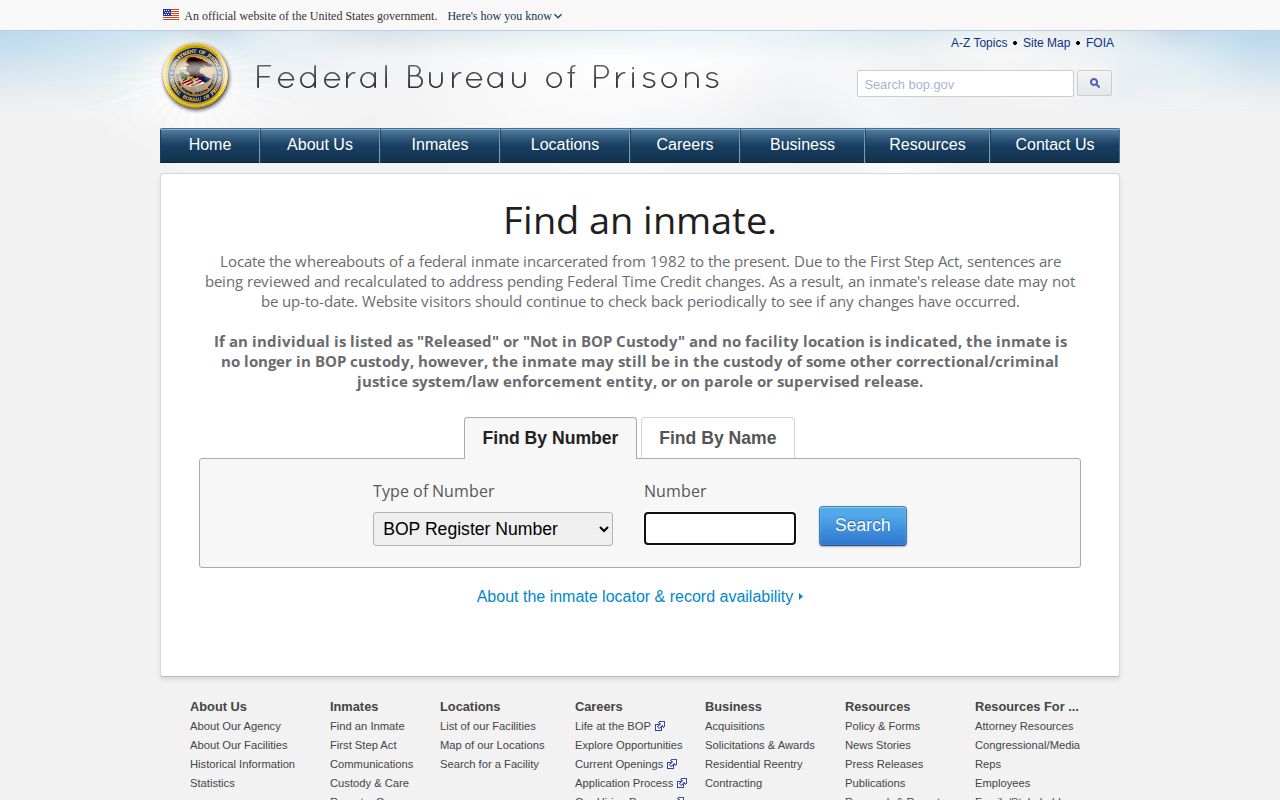
The locator is useful for BOP status, but it does not replace the Northern District of Oklahoma docket or identify every pretrial federal detainee.
Note: Use the register number across BOP, PACER, and records contacts so the federal release check stays tied to one person.
Federal USMS and PACER Checks
A person charged in federal court may remain under USMS authority before sentencing or BOP designation. The BOP locator is not a comprehensive real-time list of those prisoners. The U.S. Marshals Service prisoner information route explains the agency’s role, while the holding jail, relevant district, court counsel, or USMS contact may be needed for a specific custody question.
PACER supplies the federal legal record. Search the Northern District of Oklahoma case and read the docket in order. A detention order, release order, judgment, commitment, revocation, or supervised-release filing can explain the legal basis for custody. A case event does not by itself prove the time when a holding facility completed physical release.
- BOP custody
- Federal prison custody after designation, searchable through BOP’s historical and current locator.
- USMS custody
- Federal pretrial, transport, and court-related custody that may use contract holding space.
- PACER record
- The federal court chronology and filed orders, not a live jail roster.
- Supervised release
- A court-ordered period in the community after imprisonment, distinct from full case completion.
Federal Release Records Contact
When the BOP locator is insufficient, a former-inmate record can be requested through BOP Freedom of Information Act services. Give the full name, date and place of birth, and register number when known. Ask for the specific release or transfer document rather than an open-ended history.
Federal Custody Record Routes
BOP locator: Federal Inmate Locator
BOP records: FOIA request information
Federal court: PACER Case Locator
Pretrial custody: U.S. Marshals Service prisoner information
Hours: Check the responsible office before contact
The BOP Release and Arrival form can be especially useful when available because its fields distinguish release method, released-to destination, transportation, and supervision or reporting instructions. The record should be read with the judgment and docket. A federal supervised-release obligation may begin when prison custody ends.
A focused request should name the particular release, arrival, transfer, or custody record and give the federal register number. Do not ask BOP to infer freedom from all custody. If the response identifies another authority, take that destination as the next records route. PACER documents filed court action, while BOP or the holding custodian documents the physical agency event. A difference between those dates may reflect processing rather than an error.
Federal Release to an ICE Detainer
TCSO’s jail-information page directs ICE questions to ICE. That local instruction matters in Tulsa County because a release from a county criminal hold or a BOP institution may be followed immediately by immigration custody. The first agency’s release record should identify a destination when that field is public. Follow it before describing a community release.
The ICE Online Detainee Locator searches adults by A-number and country of birth or by biographical information. Exact spelling and identity details matter. Research notes that the public locator can include current detainees and people released from ICE custody within the prior 60 days, subject to processing, safety, identity, age, and agency limitations. It is a short post-release trace, not a permanent archive.
For the number route, use the nine-digit A-number and add a leading zero when the official instructions require it, together with country of birth. The biographical route uses exact name, date of birth, and country. A person can age beyond the locator’s short released-record window, so an old BOP release paired with no current ICE result is not proof that an immigration transfer never occurred.
A recent transfer may not appear at once. People under 18 and persons in another federal or local custody may not be displayed. Use the ICE Enforcement and Removal Operations contact route after an inconclusive result. The sibling ICE Custody and Tulsa County ICE Holds page follows that immigration path in detail.
Note: Release from BOP, USMS, or Tulsa County custody does not mean release from a documented ICE detainer or transfer.
Federal Custody at Tulsa Facilities
DLMCJC has had federal intergovernmental prisoner arrangements, but the building does not determine legal authority. A person physically held at the Tulsa County jail may remain under county, USMS, BOP, or ICE authority depending on the matter. Start with the booking and federal case identifiers, then ask which agency ordered and controls the custody.
A Tulsa County roster departure is not a federal release record. If USMS moved the person to another contract jail or BOP designated an institution, the event is a transfer. Likewise, a BOP historical release does not prove that the person was released from DLMCJC on the same date. Each custodian records its own stage.
The complete Tulsa County released inmate search separates county, state, federal, and immigration systems when the original custodian is uncertain. Use that decision path before applying a federal locator result to a local booking.
Prove a Federal Tulsa Release
The strongest federal release conclusion combines a BOP or USMS custody event with the federal docket and any receiving-agency record. For a sentenced BOP prisoner, match the register number, release wording, and date. Then inspect the judgment or later supervised-release entries in PACER. For a pretrial defendant, begin with the court and USMS or holding agency because BOP may have no record.
If the released-to field names ICE, a state department, another county, or another federal authority, use that locator or records office next. If no online match exists, try spelling and identifier variations, then ask the authoritative custodian. An old record, sealed material, data lag, or another agency’s custody can explain absence.
State the conclusion narrowly. “Released from BOP custody on the displayed date” is supported when the record says so. “Free from all custody” requires more evidence and is often not what the federal record proves.
Note: Preserve exact agency wording, access date, identifier, federal case, release date, destination, and any supervision term in the final record note.